
Jadeite Jade Rings and Earrings : The World of High Jewelry
After having your first jadeite bangle, the journey usually deepens into a set of jadeite jade rings and earrings – made from jadeite cabochons.
The jade bangle is intimate and spiritual which connects your soul to natural jadeite, and it stays quietly with you every day. While the jadeite cabochon is something shining. From there, jadeite jade steps fully into the realm of high jewelry. This is where collectors begin to compare, refine, and elevate their tastes and standards.
For serious jadeite collectors who has high budget, a few sets of premium quality jadeite cabochon ring and matching earrings of different colors and styles are a must-have. They represent concentration of color, of structure, of grain and glow, of light, of purity, of rarity, and of value.
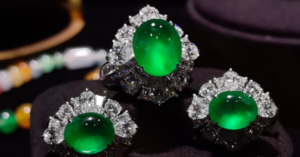
Simple in Shape, Extreme in Requirement
A jadeite cabochon looks minimal. A smooth dome. Clean polish. No carving. But this shape is actually one of the most demanding cuts in the jadeite jade world.
A cabochon exposes everything. There is no design to hide uneven color. No carving to distract from flaws. The curved surface magnifies internal texture. Even slight cotton-like structure, faint lines, or uneven grain become visible once polished.
To create a high-quality jadeite cabochon, the rough must contain a concentrated, clean, structurally fine section. Most natural jadeite rough cannot provide this. Large portions are cut away and discarded in order to isolate a suitable area. It must be eye-catching. The yield is extremely low.
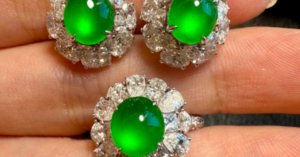
For earrings, the difficulty doubles. Two stones must match in tone, saturation, translucency, size, and dome proportion. Finding one beautiful jadeite cabochon is rare. Finding a truly harmonious pair is significantly rarer. This is why fine jadeite cabochon earrings sit firmly within the top tier of jadeite jewelry collection.
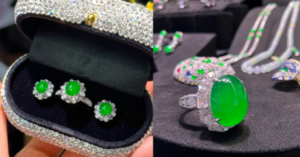
What Makes a Fine Jadeite Cabochon?
In the jadeite jade world, collectors focus on four key aspects to evaluate quality and value of a jadeite cabochon. They are color, grain and glow, clarity and cracks, shape and size.
Jadeite’s Color
Color is the most immediately perceived attribute of jadeite jade. In evaluating a cabochon, collectors apply the classic standard of "intense, bright, pure, and even" — known in Chinese as "浓、阳、正、匀".
Intense refers to what collectors call "thickness"—the color feels dense and rich, not thin or washed out. But here is the tricky part: if the color is too deep, it can start to look dark and lose its life. The sweet spot is color that is intense yet still bright.
Bright is that lively energy — what connoisseurs describe as "阳" — that makes the stone come alive under light.
Pure means the hue is free from muddy or grayish tints. The famous "imperial green" gets its rich emerald color from chromium—the same element that colors emeralds. Research shows that high-quality jadeite green actually has a slight yellow undertone.
Even means the color is uniformly distributed across the smooth, curved surface of the cabochon. Any color zoning or blotchiness is easily visible and affects the overall quality.
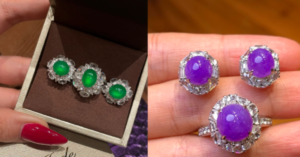
When collectors assess a jadeite cabochon’s color, they look at how well it performs on these four dimensions — whether it is a deep imperial green or a delicate lavender.
Jadeite’s Grain and Glow
In Chinese evaluation for jadeite jade, grain and glow which is called "种水" (zhongshui) in Chinese, is the foundation of jadeite’s beauty. A cabochon with beautiful color but poor grain and glow will look lifeless; a cabochon with excellent grain and glow can shine even with minimal color.
Grain refers to the texture of the jadeite—specifically, how fine or coarse its internal crystal structure is. When collectors say a piece has "old grain" (老种), they mean the crystals are so tightly packed and fine that they are almost invisible to the naked eye. When they say "new grain" (新种), the structure is looser, coarser, and often feels less solid.
Glow is what happens when the grain is fine enough. Light enters the jade, travels through its tightly packed structure, and emerges with a special energy. There are two types of glow that collectors prize:
- "起莹" (qi ying)— often translated as "fluorescence" or "glowing effect." This is a soft, floating light that seems to emanate from within the stone, usually appearing as a gentle, watery sheen along the curved surface. It is not the same as the glitter of a diamond; it is softer, more internal, almost mysterious.
- "起胶" (qi jiao)— often called "greasy" or "jelly-like" quality. The jade takes on the appearance of a drop of thick oil or melted jelly—smooth, translucent, with a sense of viscosity. When you move the stone, the light seems to flow and shift like a slow-moving liquid.
When grain and glow reach their ultimate level, they create what collectors call "light performance"—a phenomenon that top-tier players in the Chinese market now pursue the most. This is the realm of Longshi (Dragon Stone variety), the highest expression of grain and glow. Longshi is so rare that it is said to be as difficult to find as a mythical dragon. What sets it apart is its unique glow: a cold/chilling, sharp/insense, laser-like radiance that feels almost glassy cat’s eyes. In today's high-end Chinese collector market, a cabochon of imperial green Longshi, when its size is big enough for a significant ring or pendant—its value can easily reach one million US dollars.
Clarity and Cracks in a Jadeite Cabochon
When evaluating a jadeite cabochon, clarity refers to what you can see inside the stone. Natural jadeite often contains soft white inclusions sometimes described as “cotton” by collectors. These appear like faint floating fibers within the jade. Light and subtle inclusions are normal and they reflect the stone’s natural formation. However, heavy white patches can dramatically reduce the value of a cabochon. Dark mineral spots are also normal and common. A tiny speck near the edge of a cabochon may be acceptable, but bigger dark spots in the center of the dome can reduce both beauty and value.
Cracks are a more serious problem. Jadeite can contain internal lines formed long ago during its geological history. Some are healed and stable, but others may weaken the stone. Because a cabochon has a smooth curved surface, cracks are difficult to hide. A obvious crack line across the dome can lower the stone’s value a lot.
It is important to remember that natural jadeite is never perfectly flawless. Unlike glass or synthetic materials, genuine jadeite will always show some internal structure if examined closely. A small amount of natural texture or inclusion is normal and even helps confirm that the jade is real and untreated.
For collectors seeking a high-quality jadeite cabochon, the goal is not absolute perfection. Instead, the best stones are those where any natural structure remains subtle and does not distract from the two qualities collectors prize most: color and grain & glow. When viewed at a normal distance, the cabochon should appear clean, luminous, and free of obvious spots or cracks.
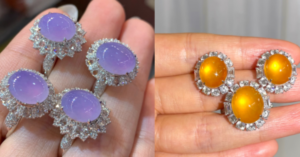
Shape and Size of a Jadeite Cabochon
When evaluating a jadeite cabochon, shape and size is another key influence on both its beauty and its value, but it is a simple to judge for everybody.
The most classic shape is the oval, which follows the natural structure of the jadeite and sits elegantly in jewelry settings. While round, pear, and other shapes exist, oval cabochons remain the most valuable and sought after by collectors.
In jadeite, the most desirable cabochons have a full, well-domed profile. Instead of appearing flat, the stone should rise smoothly from the base to a rounded peak. This height is important because the dome allows light to move through the jadeite and return to the eye, enhancing the stone’s color and glow.
Proportion also matters. For an oval jadeite cabochon, collectors often look for a balanced relationship between length and thickness. A commonly perfect proportion is close to 2:1. For example, a cabochon that measures around 10 mm in length may ideally have a thickness of about 4.5mm–5 mm. Achieving this kind of fullness is extremely difficult, especially in high-quality jadeite. Because good jadeite rough is limited, cutters are often forced to make stones thinner to avoid cracks or inclusions. As a result, thick, richly domed cabochons are so rare.
Size also plays an important role in cabochon’s value as well. Larger cabochons require larger pieces of high-quality rough, which are extremely rare. A fine cabochon measuring 15 mm can be many times more valuable than a smaller stone if it also maintains strong color, grain and glow, clarity, and a full dome.
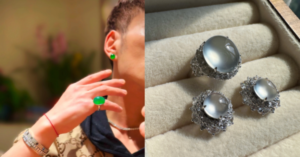
Finding Your Right Jadeite Cabochon
Choosing a jadeite cabochon ultimately comes down to understanding the balance between the four core pillars: color, grain and glow, clarity and cracks, shape and size. In reality, no single cabochon can possess absolute perfection in every aspect. For jade collectors, it is key to know what matters most to you. Some prioritize rich green color and accept minor internal cotton. Others prefer exceptional translucency
and fine grain and they accept lighter or darker color or very small size. A beautiful cabochon is one that fits both your aesthetic preference and your budget.
Cabochons are also among the most difficult jadeite pieces to judge from photographs or videos. Lighting, angles, and editing can dramatically change how a stone appears. This is why experienced collectors prefer to compare stones side by side under different lighting conditions whenever possible.
For collectors in the Middle East, Hermit Jade will soon open a store and welcome jade lovers to come, compare, and learn. We are committed to help global collectors develop a deeper understanding of jadeite quality.
For serious collectors seeking exceptional stones, our VIP sourcing service helps clients acquire top-tier jadeite cabochons. Many collectors around the world trust our expert eyes to locate rare stones that may never appear on the open market. We also welcome jade lovers to visit China for a jade discovery journey, we guide our clients through the jade markets and help them find the cabochon that truly speaks to them.
Jadeite collecting is a lifelong pursuit. With the right knowledge—and the right guide—the search for the perfect cabochon becomes part of the beauty of the journey.