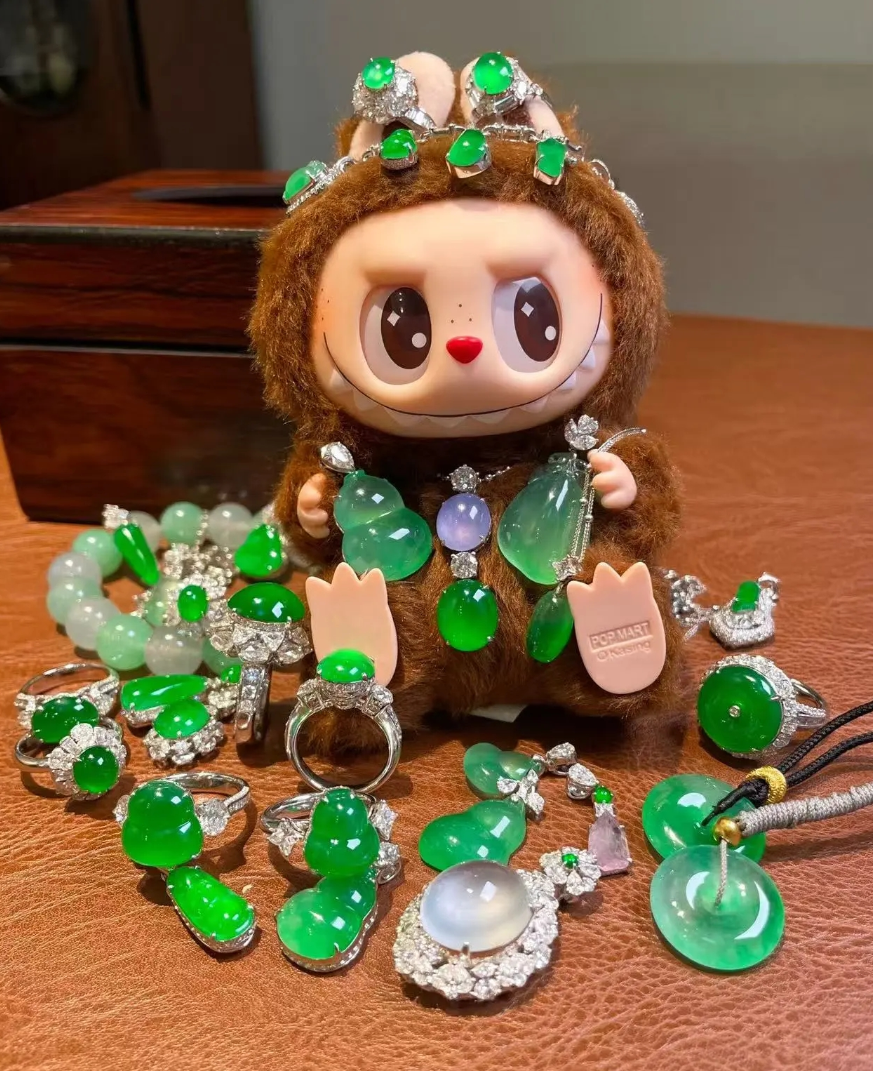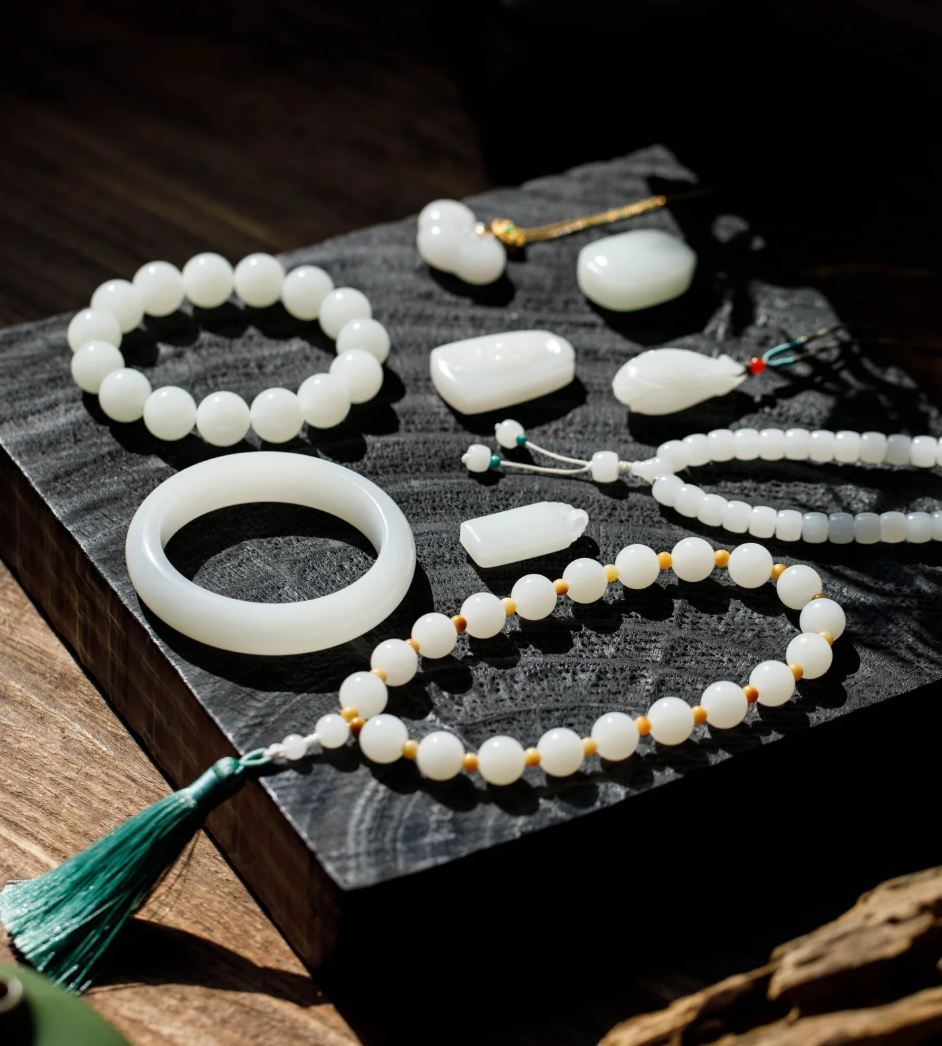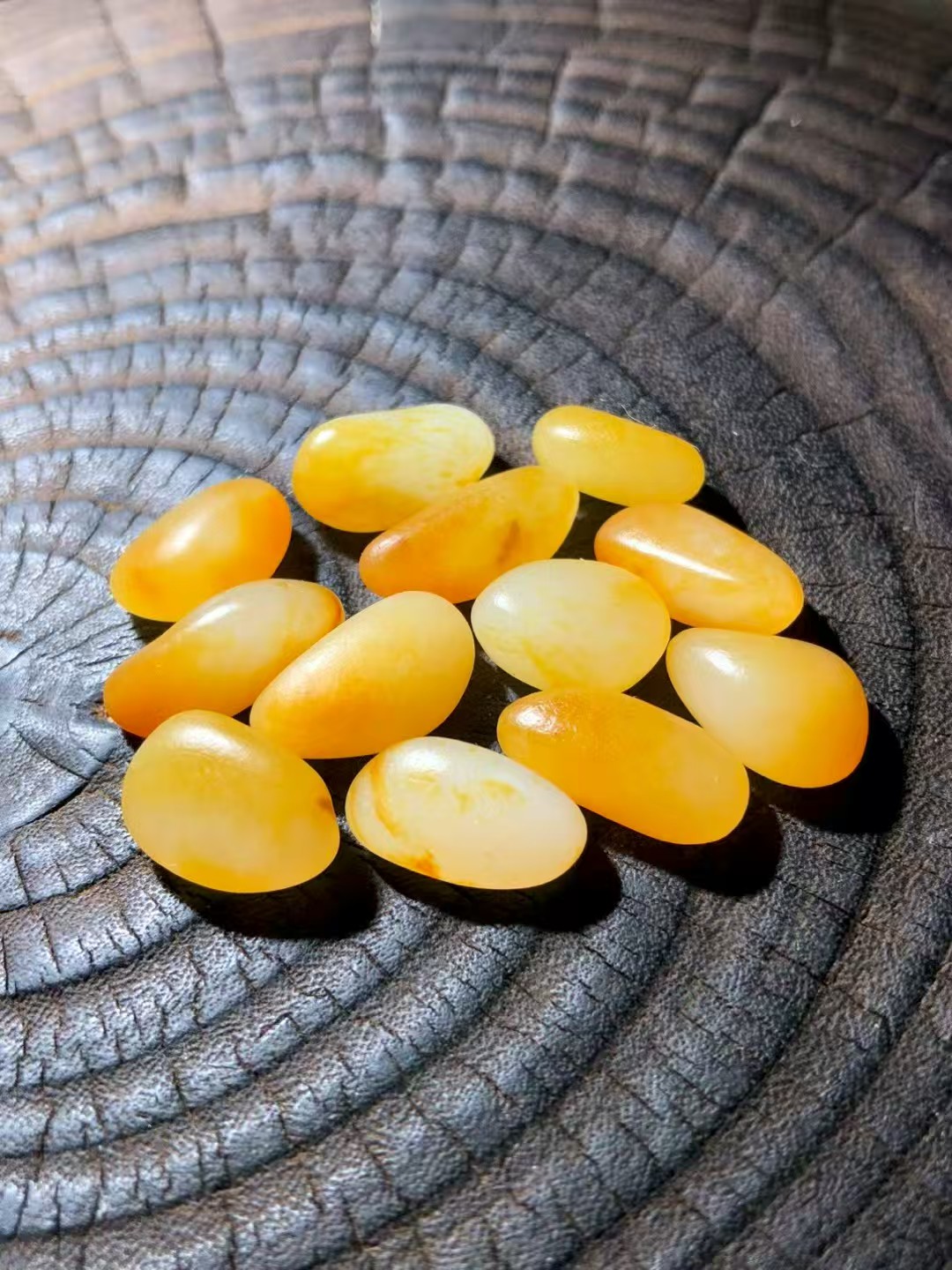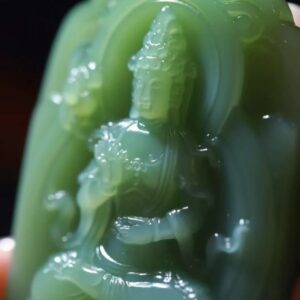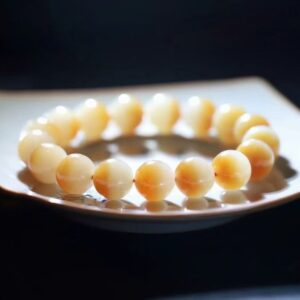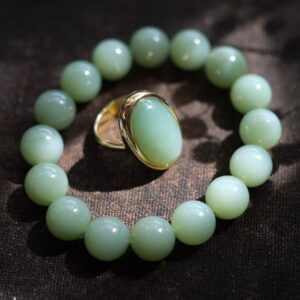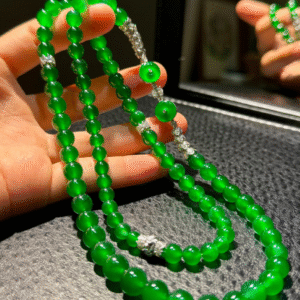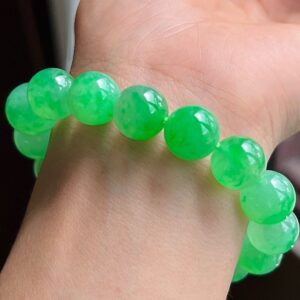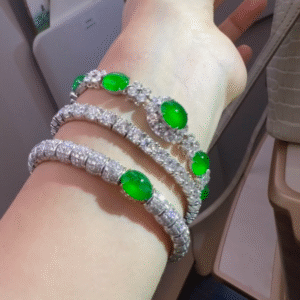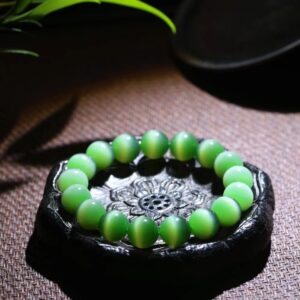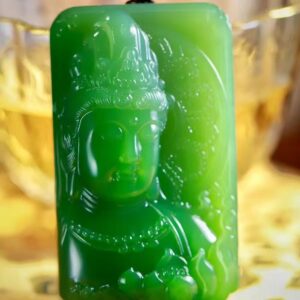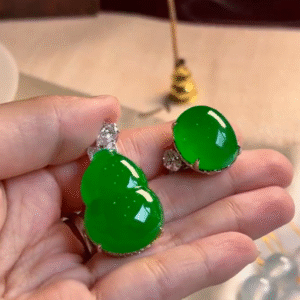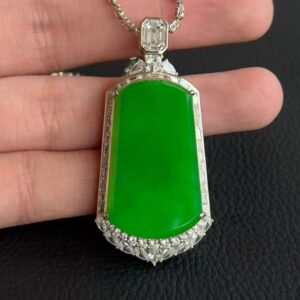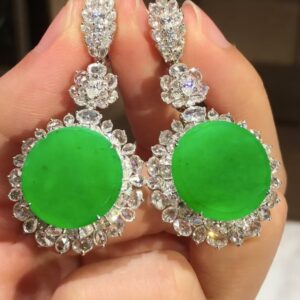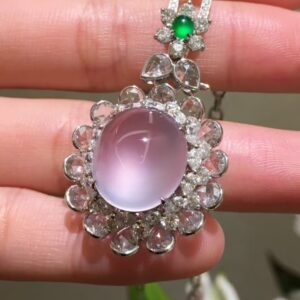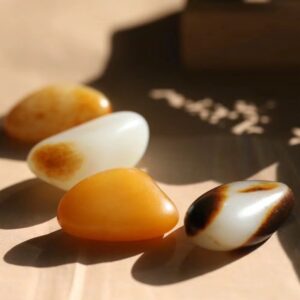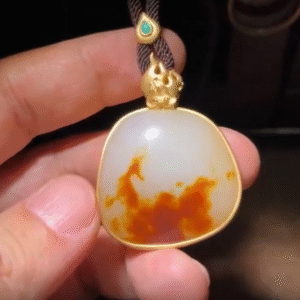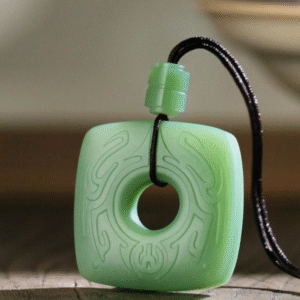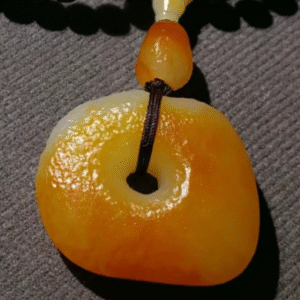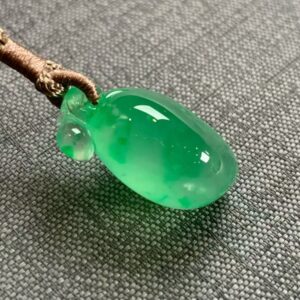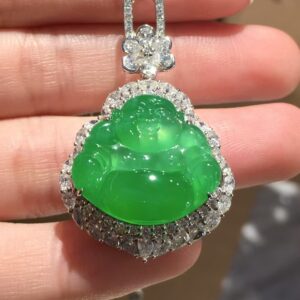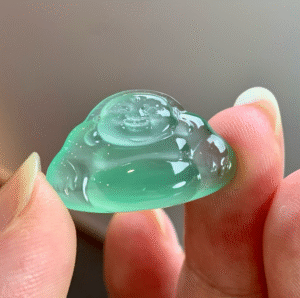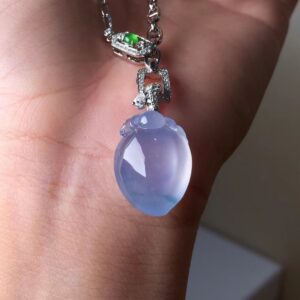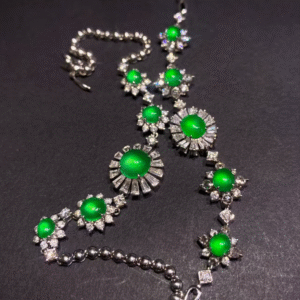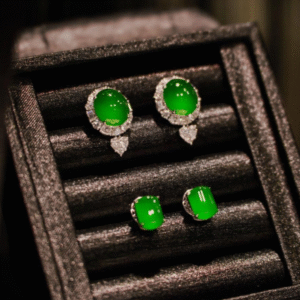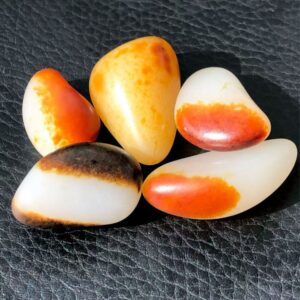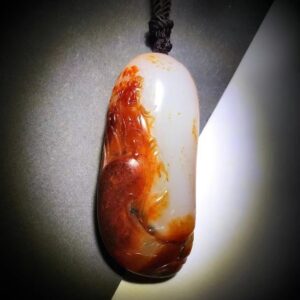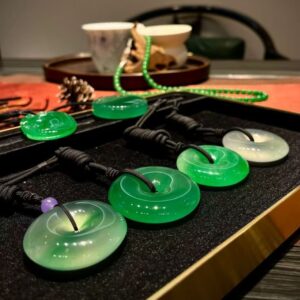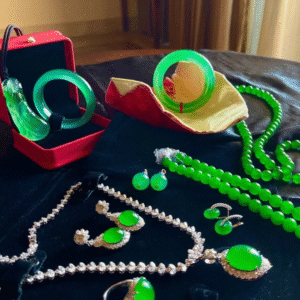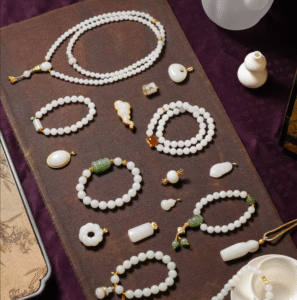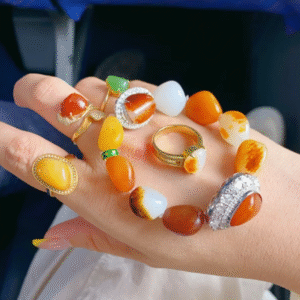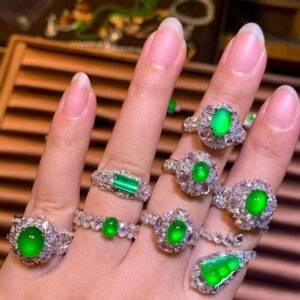
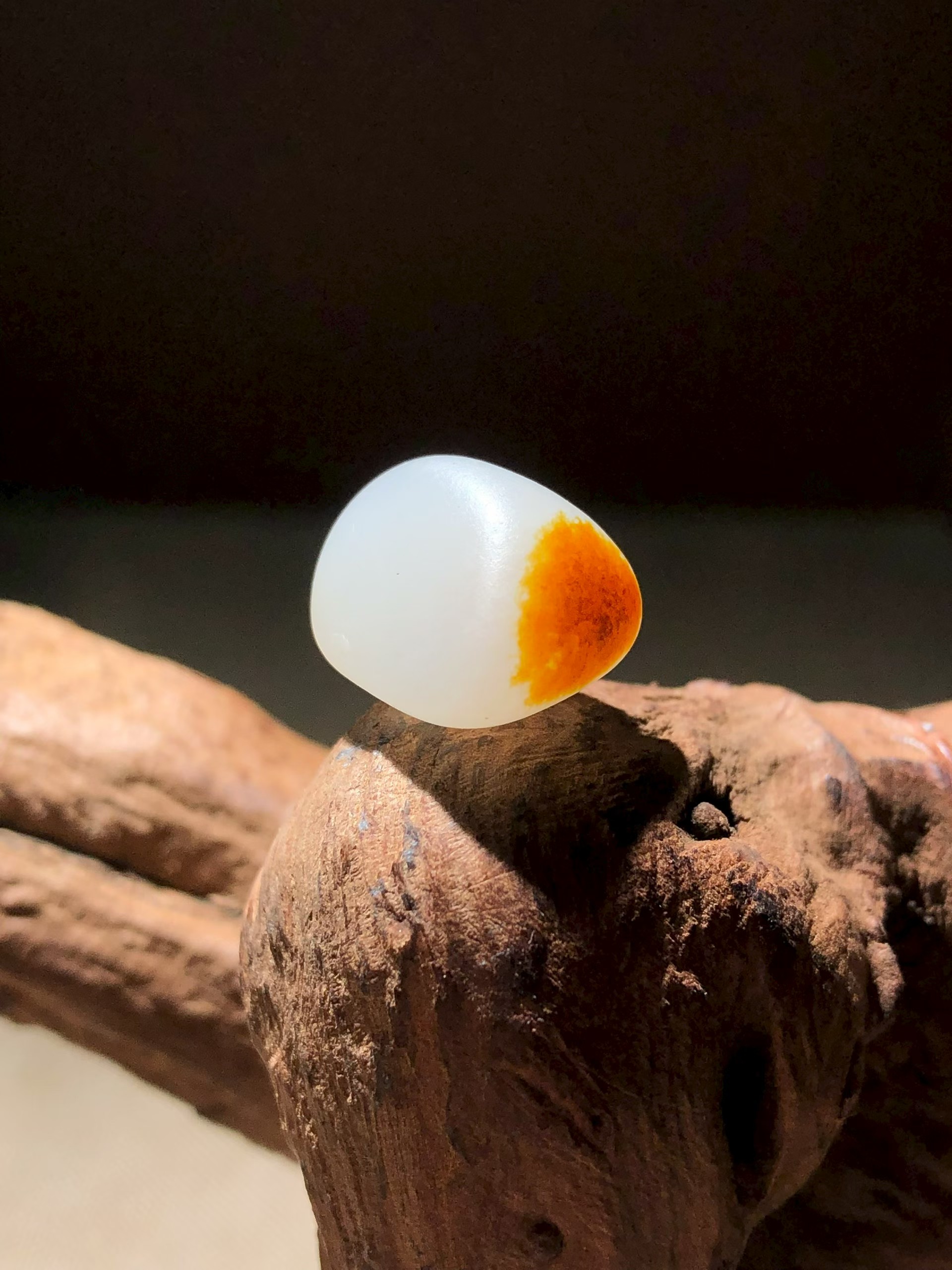
High quality natural jadeite jade Within Your Budget
High quality natural jadeite jade is increasingly seen as hard assets. From luxury jadeite jewelry to investment grade jadeite, more collectors are adding jadeite to their long-term portfolios.
But not all jadeite plays the same role in investment—and not every collector needs a top-tier budget. To build a smart collection, you need to understand how the market is structured, then choose the best pieces within your own budget and personal taste.
The Jadeite Investment Pyramid
A simple way to understand the market is through four levels:
-
Entry Level (Consumer Grade, $100~$10,000)
These pieces are widely available, often with darker tones, visible inclusions, and lower transparency. They are suitable for daily wear but have limited investment value. This level also carries higher risk of treated or imitation jadeite.

2. Commercial Level (Accessible Investment, $10,000–$20,000)
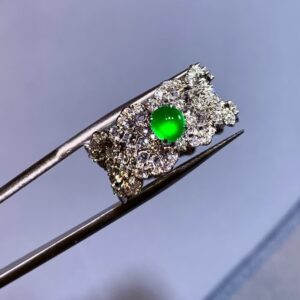
This category includes better-quality jadeite with brighter color and improved transparency. Common items include pendants, cabochon rings, and bangles with certified jadeite jewelry reports (NGTC, GIA). These pieces are more liquid and may show steady, moderate value growth. For many, this is the ideal starting point.
3. Collector Level (High-Quality Jade, ~$20,000–$200,000)
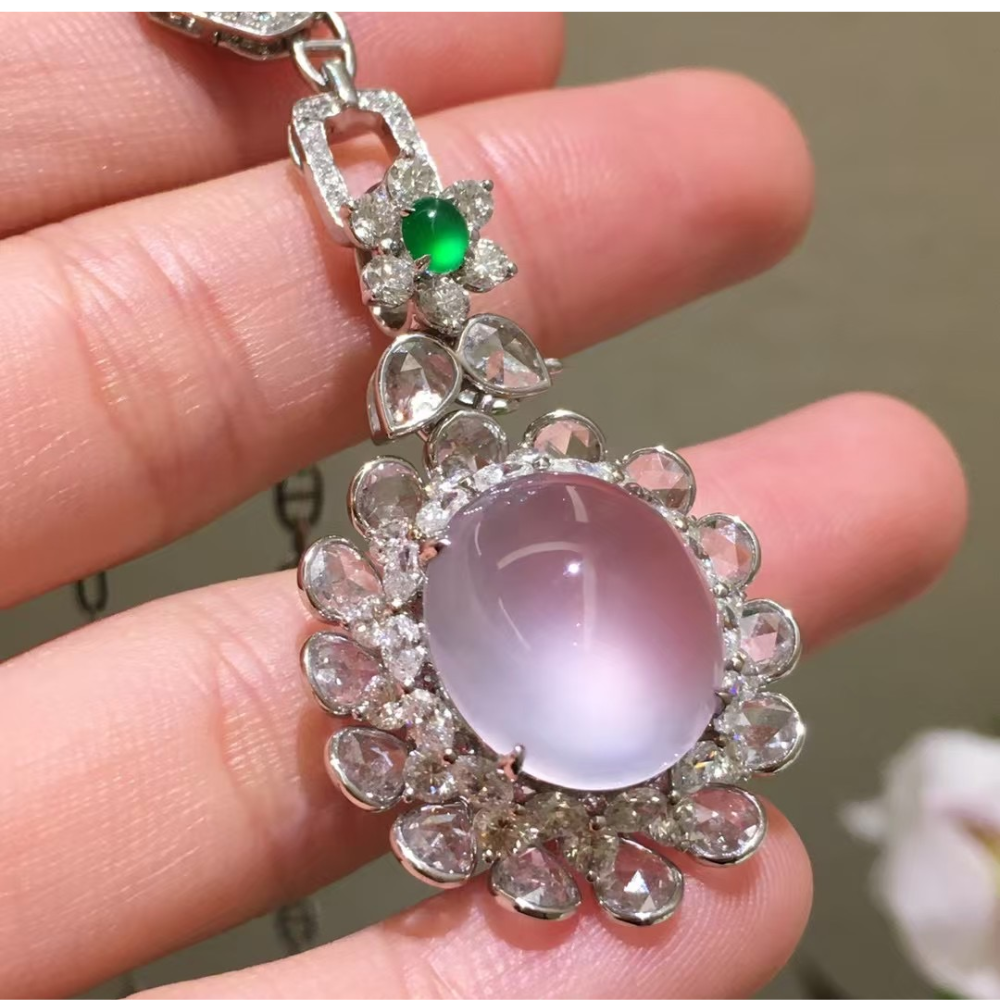
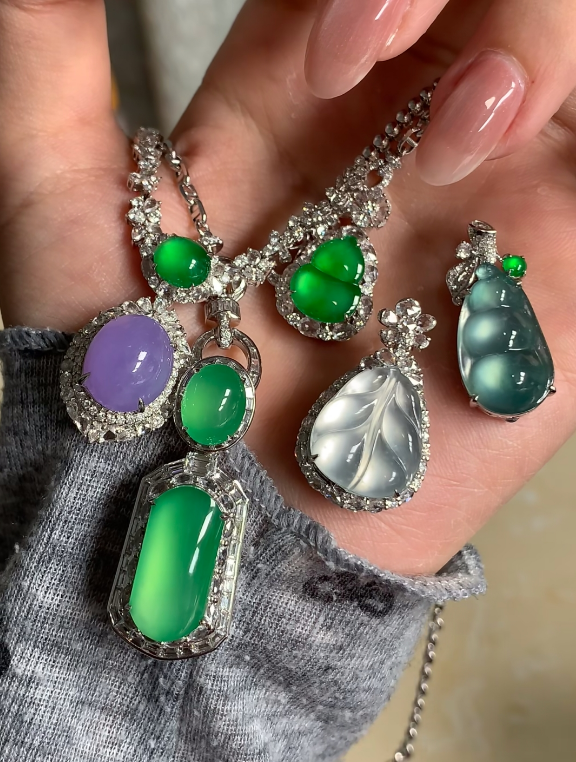
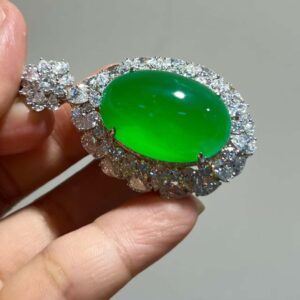
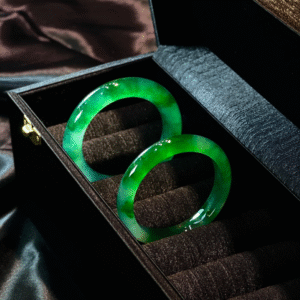
Here you find premium jade—good translucency, vivid color, clean structure, strong light performance and good size. These pieces appear in auctions and serious collections. Bangles, bead necklaces, fine cabochons and uncarved pendants are key categories. They hold value better and offer stronger long-term potential.
4. Top Tier (Investment Grade Jade, $200,000+)
This is the peak, rare collectible jadeite jewelry. These pieces feature exceptional grain and glow, vivid jadeite color, strong light performance, large size, and minimal flaws. They are extremely rare and function as global hard assets. At this level, price is driven by rarity and market recognition, often seen in major auctions.
Investment Strategy by Budget
Your strategy should match your budget. The key principle is simple: buy less, but choose the best pieces within your means, focusing on the most recognized categories in the market. For smaller budgets, focus on quality over quantity. One strong piece of fine jade is better than several average ones. For mid-range collectors, balance is important—jadeite bangles offer stability, while cabochon jewelry has strong demand and visual appeal. For higher budgets, focus only on standout pieces that show clear rarity, quality, and presence.

Building a Real Jadeite Portfolio
Successful jadeite collecting requires discipline. Learn how to evaluate color, structure, and light performance. Always buy authentic jade from trusted sources with proper certification. Follow auction results from Sotheby’s, Christie’s, and Poly to understand real pricing. Most importantly, think long term—jadeite rewards patience.
Jadeite is more than an asset. It carries cultural meaning and natural beauty that few materials can match. Each piece of natural jade is formed over hundreds of millions of years under extreme geological conditions, making it truly rare and timeless.
At Hermit Jade, we select premium jadeite and investment grade jade based on real market trends and global auction data. We guide collectors at every level with full transparency in origin, quality, and value.
Because jadeite investment is not just about price—it’s about choosing the right pieces and understanding why it matters.
Jadeite Investment:20 Years of Auction Trends and Price Growth
Jadeite Investment: 20 Years of Auction Trends and Price Growth
Jadeite, especially high quality pieces from Myanmar, has become a global hard asset. Over the past 20 years, international auctions such as Sotheby’s, Christie’s, and Poly Auction have acted as the clearest indicator of its value. By looking at auction data, we can better understand how investment grade jadeite, premium jadeite, and collectible jadeite jewelry have evolved.

Jadeite Investment 20 Years of Auction Trends and Price Growth (1)
Four Phases of the Jadeite Auction Market (2005–2025)
1. Growth Phase (2005–2010)
As China’s wealth grew, demand for natural jadeite and luxury jade jewelry increased rapidly. In 2009, a jadeite bangle sold at Christie’s Hong Kong for HKD 15.68 million, setting a new benchmark. Prices for mid- to high-end jadeite rose by 20–40% annually.
2. Boom Phase (2011–2017)
This period saw record-breaking prices. In 2017, the “Hutton-Mdivani Jadeite Necklace” sold for HKD 72.62 million at Sotheby’s. In the same year, a full green jadeite bangle reached over HKD 500 million at Poly Auction. Imperial jade and top-tier pieces became global trophies.
3. Adjustment Phase (2018–2022)
The market became more rational. While top-quality jadeite remained strong, mid- and lower-tier pieces corrected by 20–30%. After COVID, online auctions increased, and buyer behavior became more selective.

Jadeite Investment 20 Years of Auction Trends and Price Growth (5)
4. Divergence Phase (2023–2025)
The market split clearly. Top investment grade jadeite continued to rise, while lower-quality jade stagnated. In 2025, a jadeite bangle sold for RMB 280 million, showing that the best pieces are still in extreme demand.

What Drives Auction Prices?
Auction results reveal clear patterns behind value:
-
Changing Preferences
- 2005–2015: Bangles and beads dominated the market
- 2016–2020: Cabochons (small but perfect pieces) became popular
- 2021–2025: Matching sets and collections gained attention
2. Global Buyers
Early buyers were mainly from Hong Kong and Taiwan. Today, collectors from Mainland China, Southeast Asia, Europe, and the US all participate. Institutional buyers such as family offices are also entering.
3. Key Value Factors
Collectors consistently focus on four elements:
- Texture (structure and transparency) – ~40% importance
- Color – ~40%
- Craftsmanship – ~10%
- Shape and size – ~10%
The highest premiums go to pieces that combine glassy texture, imperial color, large size, and no cracks.

Iconic Auction Examples
- 2017 – Hutton-Mdivani Necklace (Sotheby’s)
A historic jadeite bead necklace increased over 7 times in value since its earlier sale. - 2019 – Jadeite Cabochon Ring (Christie’s New York)
A top-quality cabochon reached HKD 32 million, showing growing global acceptance of real jadeite jewelry. - 2025 – Full Green Jadeite Bangle (Poly Auction)
Sold for RMB 280 million after intense bidding. Large size and flawless quality made it a strategic asset.

What This Means for Investors
The past 20 years show a clear trend:
- Top investment grade jadecontinues to rise
- Mid-level fine jadeitegrows steadily
- Low-end jade has little investment value
At Hermit Jade, we closely follow global auction results and market trends. Our experts continuously study price movements, collector behavior, and supply changes to guide our clients. We help collectors select collectible jade jewelry that align with long-term asset strategies.
Jadeite Certification: Buy Jadeite with Confidence
When buying jadeite jewelry, many buyers rely on certificates because a laboratory report is the proof of authenticity. In this blog, we explain about jadeite certificates for readers to better understand details and avoid common traps in the jadeite market.
What a Jadeite Certificate Confirms
Standard jadeite certificates focus on one key point: confirming that the material is natural jadeite (Type A / Grade A). This means the jadeite has not been chemically treated, dyed, or polymer-injected.
Certificates may also include basic details such as color, transparency, shape, and size. However, these descriptions are usually general and should not be used to judge the quality or value of the jadeite.
Authoritative Jadeite Certification Labs
In China, gemstone testing follows national standards GB/T 16552 and GB/T 16553. An authoritative certificate must include three accreditation marks:
- CMA(China Metrology Accreditation)
- CAL(Approval for Testing Laboratory)
- CNAS(China National Accreditation Service for Conformity Assessment)
Major trusted institutions include:
- NGTC (National Gemstone Testing Center)
Directly under the Ministry of Natural Resources. The highest authority in China and the most widely recognized globally. - GIC (Gemological Institute of China, China University of Geosciences)
University-backed institution with strict academic standards and strong market credibility. - GTC (Provincial Gem Testing Centers)
Reliable regional authorities offering a balance of professionalism and accessibility.
International labs (GIA, IGI)
Commonly used for cross-border collections and high-end jewelry.

Jadeite Certification Buy Jadeite with Confidence (1)
How to Read a Jadeite Certificate
Experienced buyers usually go straight to the most important section: “Identification Result.” As long as it states Type A jadeite, Grade A, or Natural jadeite (A), it confirms the piece is genuine jadeite with no chemical treatment. This is what you should always look for first. Type B/C/B+C are all with chemical treatment and have no value.

Jadeite Certification Buy Jadeite with Confidence (2)
Apart from the identification result, certificates also list a few physical properties:
- Refractive Index (~1.66)
A typical optical property of jadeite. Most imitations cannot match this. - Density (~3.33)
Genuine jadeite feels dense and “heavy in hand,” unlike glass or other imitations. - Microscopic Structure
Natural jadeite shows a fine, interlocking fibrous crystal structure under magnification.

Jadeite Certification Buy Jadeite with Confidence (3)
Steps to Verify a Certificate
To avoid fake or “borrowed” certificates, buyers can verify online as per below steps:
- Scan QR code or enter certificate number on the official website to confirm consistency.
- Check the accreditation marks, they must include CMA and CNAS.
- Check the stamp and signature, it must include clear official stamps or traceable digital signatures.
- Verify weight consistency, the recorded weight should match the actual stone within 0.01g.
Review the testing logic, be cautious if key scientific data (e.g., spectroscopy or standard gem testing indicators) are missing or vague.
How Jadeite Entered China and Became Imperial Treasure
For thousands of years, Nephrite was the only jade revered in Chinese culture for its soft luster, earthy hues, and ease of carving perfectly aligned with Confucian ideals, burial rites, and imperial symbolism. Jadeite, as a rarer and more vibrant form of jade was introduced to China only at the late Qing dynasty. It was Empress Dowager Cixi, the powerful and influential ruler of the Qing dynasty, who became enamored with Jadeite. Her fascination with the stone elevated it to a symbol of luxury and prestige within China's high ranks.
The Jade Road from Burma to China
Jadeite first came into China through trade with Myanmar (formerly Burma). Trade between China and Burma began long before Jadeite gained its recognition in China. By the 13th and 14th centuries, small quantities of raw Jadeite had trickled into China’s Yunnan Province via ancient caravan routes—part of a less known network called the Jade Road, which was a quiet route compared to the famous Silk Road.
Curiosity and Craftsmanship
At first, Chinese artisans and scholars viewed the new stone with skepticism. It was too hard for their traditional tools. Its brilliance—especially in vivid greens—felt harsh compared to the soft glow of Nephrite. It didn’t fit the visual language of refinement they had cultivated for centuries.
Yet curiosity prevailed. In Yunnan, where hardstone carving already flourished, artisans began experimenting with the unfamiliar material. They discovered that Jadeite could be polished to a mirror finish and carved with greater precision. Its hardness allowed for sharper details. And when the color was right, the stone seemed to glow from within—radiant and full of life.
As more pieces were worked and shared, Jadeite gradually earned respect. During the late Ming Dynasty, interest grew among merchants and collectors in southern China. Although rare and expensive, its beauty and novelty made it an object of fascination. Without standardized grading systems, traders relied on instinct and experience—cultivating the rare skill of “seeing through stone.”
How Jadeite Became Imperial Treasure
By the 17th century, knowledge about Jadeite had quietly spread through southern China, especially among wealthy families and artisans. But its presence was very limited. The stone's rarity and the difficulties of overland trade kept it from spreading widely. Additionally, the cultural dominance of Nephrite jade kept Jadeite from gaining prominence. However, the aesthetic values of China's elite were starting to shift, a new appreciation for brighter colors, higher polish, and finer detailing was quietly growing.
Jadeite's rise to imperial status came only in the 19th century during the Qing dynasty. It was Empress Dowager Cixi, one of China's most powerful and influential women, who played a key role in bringing Jadeite into the imperial court. Enchanted by the stone's dazzling colors and rich, varied textures, Cixi became an avid collector and a key promoter of Jadeite within the royal circles.
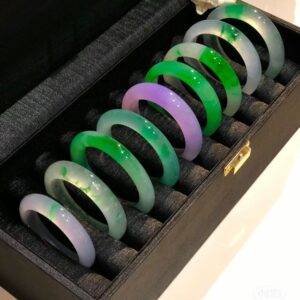
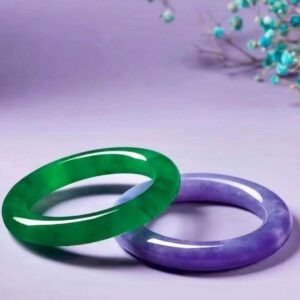
The introduction of Jadeite to the imperial court marked a significant cultural turning point. Its vivid greens, rich purples, and translucent whites brought a new form of beauty to China. Jadeite's rise in the imperial court not only redefined the nation's understanding of jade but also signaled a shift in its appreciation of luxury, beauty, and refinement. As it became the stone of choice for imperial jewelry, ornaments, and ceremonial objects, Jadeite earned its place as a true imperial treasure. After the Qing dynasty, Nephrite was no longer the sole jade revered in China; Jadeite, with its vibrant colors and luxurious appeal, became equally significant and continued to be cherished for centuries to come.
How to Tell Burmese Jade vs Guatemala Jade
When it comes to premium jadeite, understanding the difference between Burmese jade vs Guatemala jade is essential for collectors, investors, and jewelry buyers. The origin of jadeite significantly affects its value, rarity, and overall appearance. While both types can look similar at first glance, there are key differences that help distinguish them.
Burmese Jade vs Guatemala Jade: Color Tone Differences
Warm vs Cool Undertones in Burmese Jade vs Guatemala Jade
One of the most important indicators in identifying Burmese jade vs Guatemala jade is the color tone. Burmese jadeite typically shows a warm, vibrant glow, even in deep green shades like imperial green. In contrast, Guatemala jadeite often appears cooler, with bluish or grayish undertones.
How to Observe Color in Burmese Jade vs Guatemala Jade
Under natural daylight, Burmese jade looks brighter and more lively, while Guatemala jade may appear darker and less saturated—especially when viewed from different angles. Rotating the stone helps reveal how stable the color remains.

Burmese Jade vs Guatemala Jade
Burmese Jade vs Guatemala Jade: Light Performance
Living Light vs Surface Reflection in Burmese Jade vs Guatemala Jade
Another key difference in Burmese jade vs Guatemala jade is how light interacts with the stone. Burmese jadeite is known for its “living light,” where light enters and diffuses within the stone, creating a soft, moving glow.
Guatemala jadeite reflects more light from the surface, making it appear flatter and less dynamic.
How to Test Light Performance
Hold the jade near a natural light source and rotate it slowly. Burmese jade will show internal movement of light, while Guatemala jade will reflect light more statically.

Living Light vs Surface Reflection in Burmese Jade vs Guatemala Jade
Burmese Jade vs Guatemala Jade: Thickness and Structure
Thickness Impact on Burmese Jade vs Guatemala Jade
Burmese jadeite maintains its beauty even when cut thicker. Its color remains stable, and the stone continues to glow from within. Guatemala jadeite is more sensitive to thickness and is o

Burmese Jade vs Guatemala Jade Thickness and Structure
ften cut thinner to enhance its appearance.
Crystal Structure Differences in Burmese Jade vs Guatemala Jade
Burmese jade has a fine, compact crystal structure, giving it a smooth appearance. Guatemala jade tends to have a slightly grainy or coarser texture, sometimes visible under magnification.

Burmese Jade vs Guatemala Jade Clarity and Inclusions
Burmese Jade vs Guatemala Jade: Clarity and Inclusions
Inclusion Patterns in Burmese Jade vs Guatemala Jade
In Burmese jade vs Guatemala jade, inclusions appear differently. Burmese jadeite often shows soft, mist-like inclusions that blend naturally into the stone.
Guatemala jadeite may have more noticeable inclusions, such as darker spots or clustered patterns.

Burmese Jade vs Guatemala Jade Color Distribution
Burmese Jade vs Guatemala Jade: Color Distribution
Blended vs Segmented Color in Burmese Jade vs Guatemala Jade
Color distribution is another distinguishing factor in Burmese jade vs Guatemala jade. Burmese jade typically has smooth and natural color transitions.
Guatemala jade often shows more segmented or patchy color areas, with visible boundaries between colors.

How to Tell Burmese Jade vs Guatemala Jade (7)
Final Thoughts on Burmese Jade vs Guatemala Jade
Understanding the differences between Burmese jade vs Guatemala jade helps buyers make informed decisions, especially when investing in high-quality jadeite jewelry. By observing color tone, light performance, structure, clarity, and color distribution, you can more confidently identify the origin and value of your jade.
Jadeite Beads: The Most Versatile and Personal Form of Jadeite Jewelry
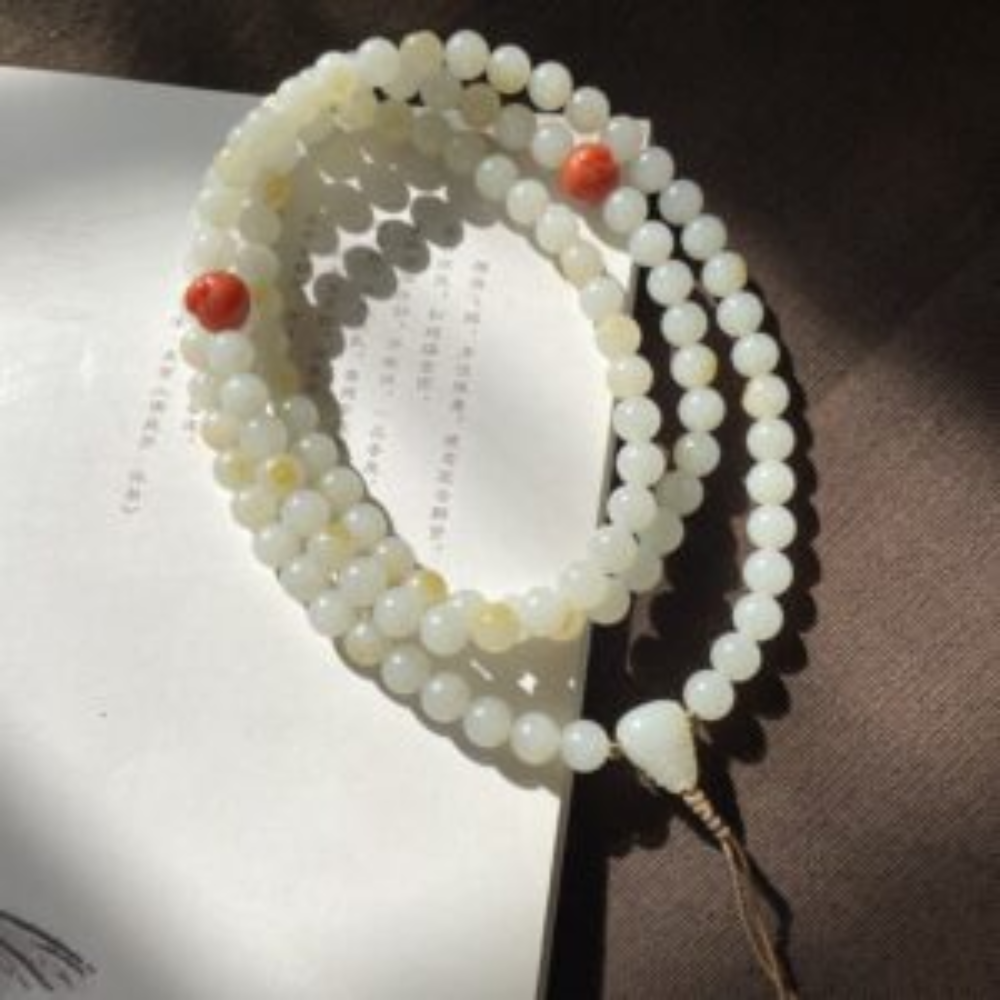
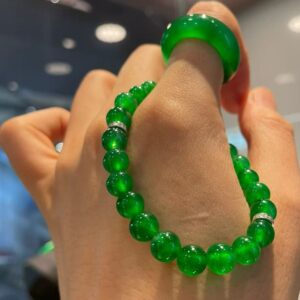
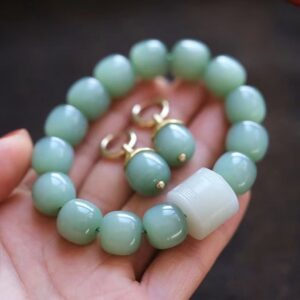
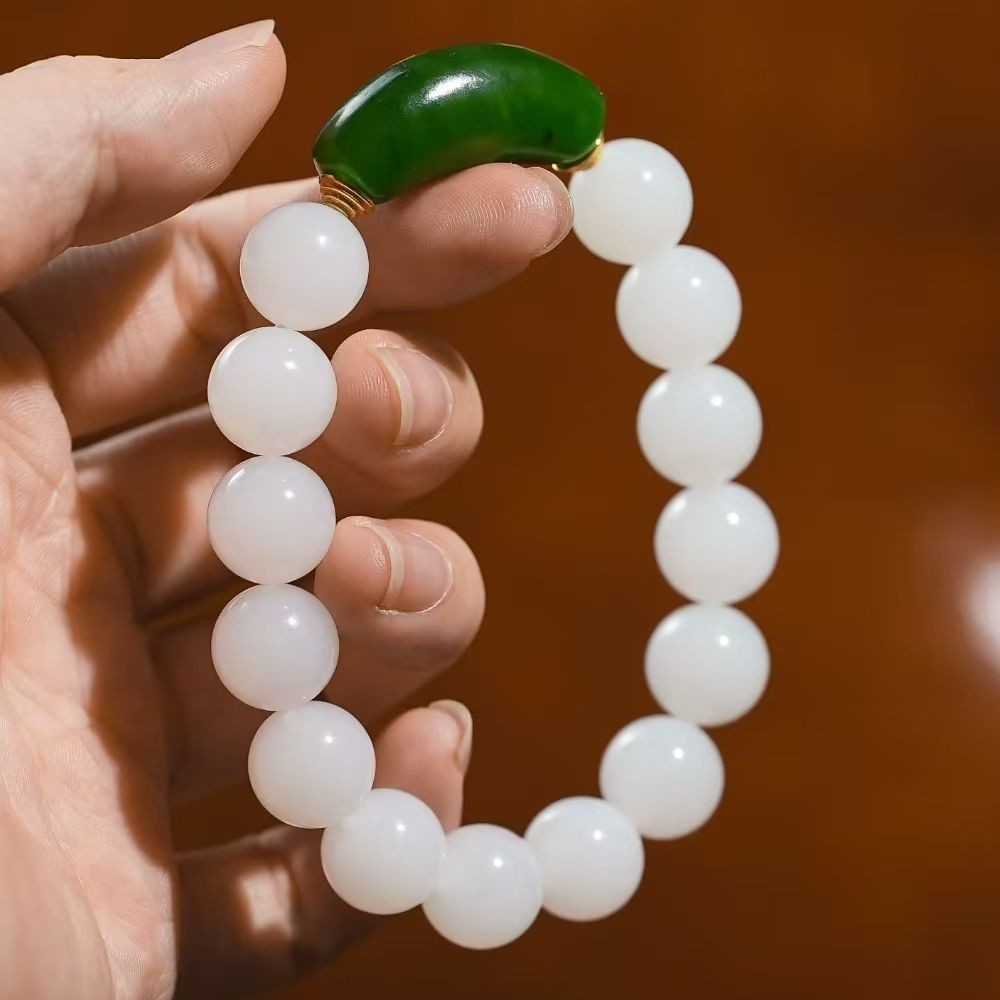
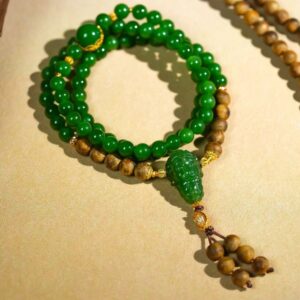
Among all jadeite jewelry, jadeite beads are the most versatile—and for many collectors, the most enjoyable. They can be collected one by one, combined in different ways, and redesigned over time. No other form of jade offers this level of personal expression. They look simple, round, smooth, minimalist. Yet behind this simplicity lies one of the most demanding and luxurious forms of jadeite.
In the jadeite world, there is a famous saying: “High-quality jade is rarely used to make beads.” This saying reflects an important truth: creating a beautiful jadeite bead necklace or jadeite bead bracelet requires a huge amount of jade material and extremely high-quality raw stone. Because of this, fine jadeite beads have become some of the most respected treasures among serious jade collectors.

Why Jadeite Beads Require So Much Jade Material
Among all jadeite jewelry types (jade bangles, jade cabochons, jade pendants, and jade carvings), beads require the most raw material.
When carving a pendant, artisans can follow the natural shape of the jade and avoid flaws. When making a jadeite cabochon, only a small section of the best material is required. But jadeite beads are different. Each bead must be carved from a solid piece of jadeite in order to form a perfect sphere. For example: A high-quality 18-bead jadeite bracelet requires a lot more raw jade material than a jade pendant or even a jade bangle of similar weight. Beads are also extremely strict about cracks. A pendant may hide imperfections through carving. A bead cannot hide anything. If a crack appears during cutting, the bead becomes unusable.
This is why high-quality jadeite bead bracelets and necklaces are extremely rare. Most jade bead bracelets available on the market today are made from lighter colored jadeite or lower-grade material. Very occasionally, higher-quality beads appear, but they are usually small — often under 7mm in diameter. Large high-quality jadeite beads are extremely hard to obtain and are mostly in wealthy collectors’ hands.
Jadeite Bead Necklaces: The Ultimate Treasure for Jade Collectors
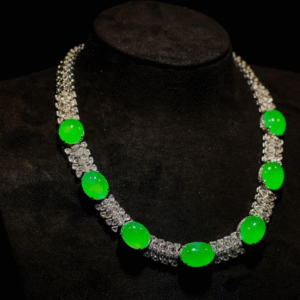
At international auctions, jadeite bead necklaces are often the most valuable jade jewelry pieces. One famous example occurred in Hong Kong. In 2014, a natural jadeite bead necklace sold for HKD 214 millions, setting a record for jade jewelry. The necklace contained 27 perfectly matched Burmese jadeite beads, each approximately 15mm in diameter. They were cut from the same jadeite rough stone, all beads from one same raw stone, having the same color, transparency, texture and quality.
Why are jadeite bead necklaces so valuable? Because assembling one is extraordinarily difficult and expensive. First, you must discover a large piece of high-quality natural jadeite with excellent grain and glow, attractive color, minimal impurities, no structural cracks. Then the jade must be cut into dozens of perfectly round beads. Each bead must be symmetrical, flawless, consistent in color, identical in size. This rarity makes jadeite bead necklaces one of the most desirable pieces in the world of jade collecting.

How Experts Evaluate Jadeite Beads
Experienced collectors evaluate jadeite beads and jade bead bracelets based on several key factors.
1. Jadeite Quality: Color, Transparency, and Purity
Like jade cabochons, jadeite beads have smooth surfaces without carving. This means the jade itself must be naturally beautiful. And like any other jadeite category, beads have the same evaluation standard in terms of quality.
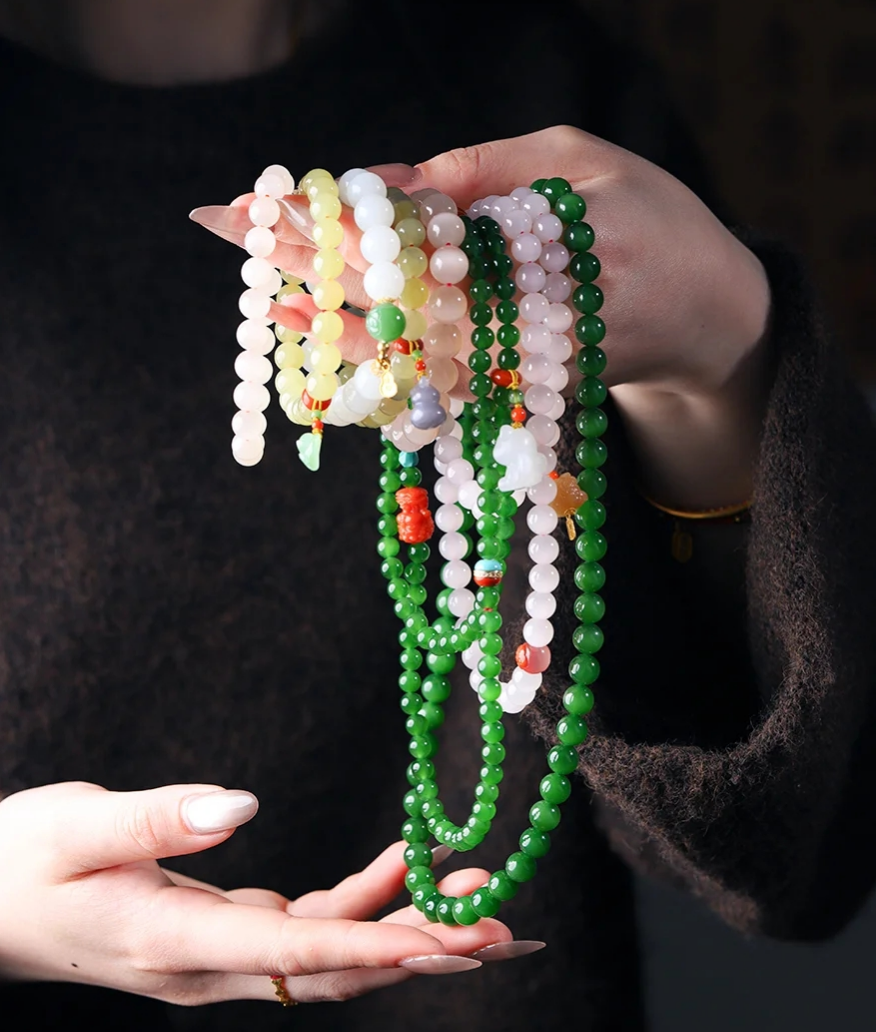
Color: For jadeite bead necklaces or bracelets, while senior collectors prefer bright or intense color, they also look for consistency in color or how the beads match with each other as a whole. Whether the beads are imperial green jadeite, lavender jadeite, bright yellow or red, icy white jadeite, floating green jade, or blue hue jadeite, the entire necklace or bracelet should feel visually harmonious and beautiful.
Transparency (grain and glow):
beads with higher grain and glow are far more expensive. Wealthy collectors prefer ice-type or even glass-type jadeite beads, appearing luminous and clear like frozen water droplets, with beautiful light and glow. Lower-quality jadeite beads appear cloudy or dull.
Purity and flaws: Like we mentioned many times, there is never a perfectly looking natural jadeite piece, and it is the same for beads. When choosing beads for collection, the standard is each bead is clean enough and there is no cracks or visible flaws under human eyes. Seasoned collectors will not expect a bead to be as clean as jadeite cabochons.

2. Structural Integrity: Same or Similar Material
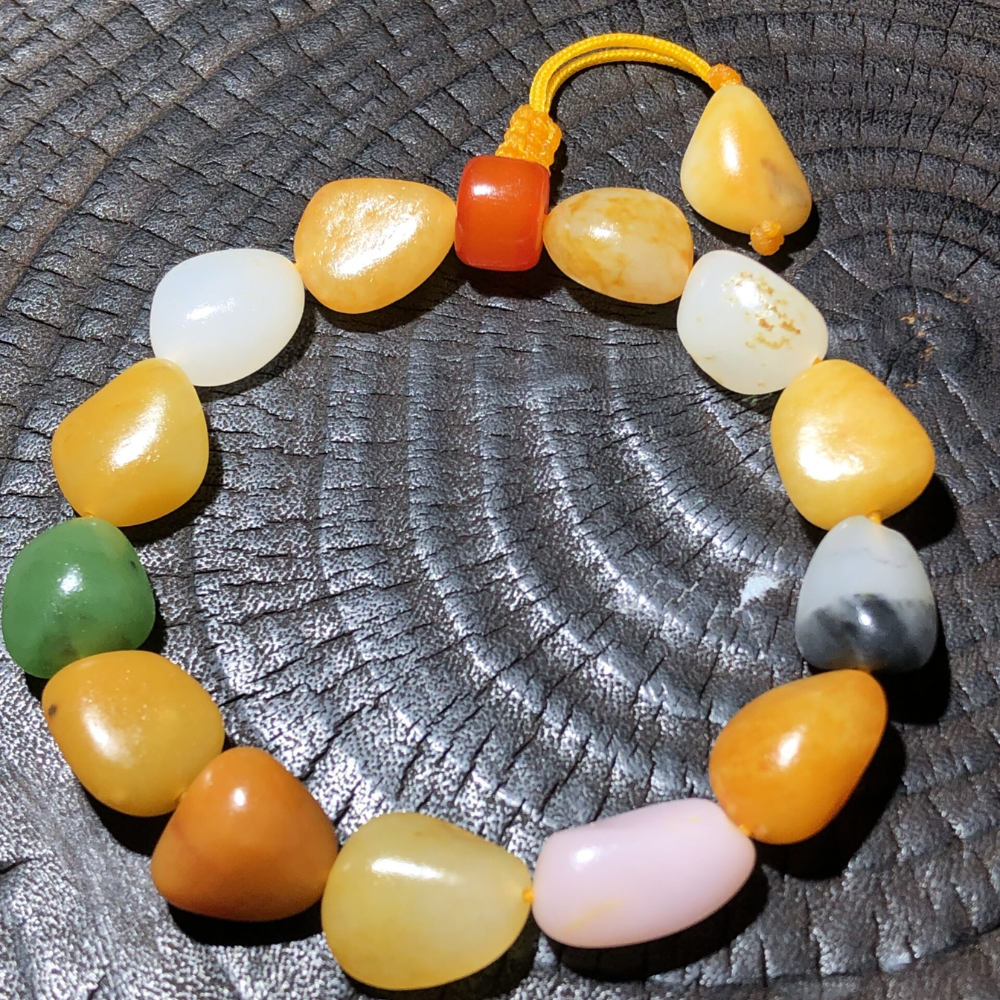
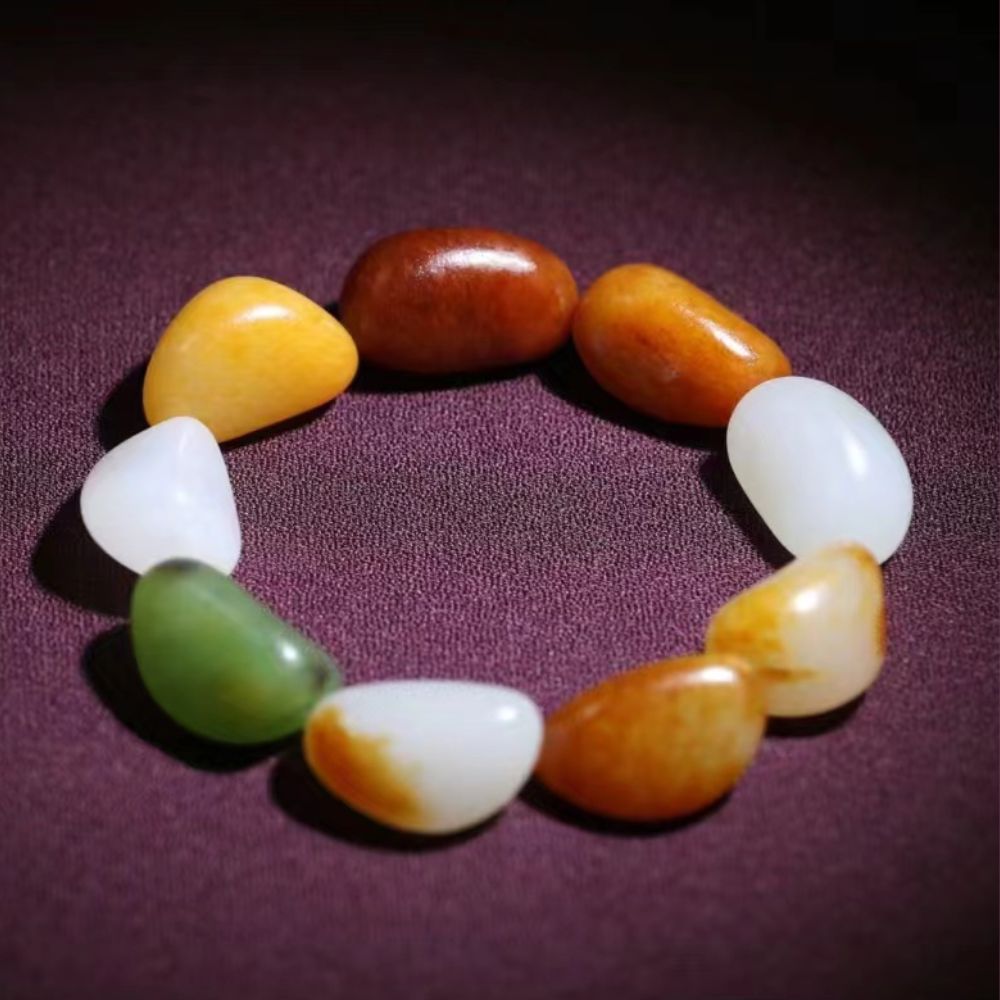
The best jadeite bead necklaces or bracelets are cut from a single jade stone. This ensures consistency in color, transparency, and texture. If beads come from different stones, subtle differences become visible. For rainbow bracelets, where collectors collect beads of different colors one by one, the transparency and texture should be similar so it looks harmonious and with smooth visual flow when made into one bracelet.

Shape and Size
3. Shape and Size
The most classic and valuable bead shape is the perfect round jade bead. A true round bead must be symmetrical in every direction. If the bead becomes slightly oval or flattened, its value drops. Other shapes also appear in jade bead jewelry, such as barrel beads, old-style beads and abacus beads. However, perfectly round beads remain the most traditional and valuable.
True Jadeite vs. Fake Jadeite
True Jadeite vs. Fake Jadeite[/caption]True Jadeite vs. Fake Jadeite
Not All Jadeite Is Real Jadeite
Today’s market has plenty of jade jewelry (jadeite jewelry), jade rings (jadeite rings), jade bangles (jadeite bangles), and jade bracelets (jadeite bracelets), not only in China, they are also available in Dubai and across the UAE. Some pieces appear beautiful and bright, some sellers even mark them as "luxury." But the question is: Are they real jadeite?
In the world of collectors and connoisseurs, one basic concept is that only Type A jadeite is regarded as true jade. Everything else, including Type B and Type C jadeite, is considered fake jadeite, no matter how attractive the stones may appear. While Type A jadeite is pure, natural, and unaltered, much of the jadeite jade sold in the UAE is chemically treated or artificially enhanced, significantly reducing its value and authenticity.
In the UAE, especially in Dubai high-class circle, jade and jadeite has been known as associated with wealth, status, and luxury. However, it is not easy to get a true one, so understanding the differences is critical for anyone purchasing jade jewelry or looking to invest in authentic jadeite rings, jadeite bangles, or jadeite pendants

True Jadeite vs. Fake Jadeite
The Three Main Types of Jadeite Explained
Type A Jadeite – The True Jadeite (Authentic Jade)
- 100% natural, untreatedjadeite
- No chemical treatment, no dyeing, no resin or polymer used
- Only cut, carved, and polished by hand
Type A jadeite is the gold standard and the only form of jadeite considered real jade. When looking for authentic jadeite jewelry in Dubai or the UAE, Type A is the only type worth investing in.
Type A jadeite is prized for its natural beauty and power, vivid colors, and long-lasting durability. The stone retains its color, shine, and value over time, making it perfect for fine jade rings, jadeite bangles, and custom jewelry pieces. One thing to note is that Type A jadeite is rarely perfect; you can always find some flaws in it, and its imperfections are what make it even more charming, teaching collectors to embrace the true nature of the world (imperfection).
Type B Jadeite – Chemically Treated Jadeite (Fake Jadeite)
- Chemically treated to remove internal flaws
- Injected with polymer to enhance translucency
- Bad for health in long term
Type B jadeite may appear to have a clear, clean appearance but lacks the natural structure and integrity of Type A. While it may look good initially, Type B jadeite is structurally compromised, leading to long-term deterioration. In the UAE’s high-end jewelry market, Type B jadeite is considered inferior and should be avoided by serious buyers.
Type C Jadeite – Dyed Jadeite (Fake Jadeite!)
- Dyed to artificially boost color, especially to mimic the vivid greens of Imperial jadeite
- Color fadesover time with exposure to sunlight or skin oils
- Bad for health in long term
Type C jadeite is often sold as jadeite jewelry in Dubai, particularly as colored jadeite pendants, jade rings, and green jade bangles. However, dyed jadeite lacks the natural qualities of Type A jadeite and is considered a poor investment by serious collectors.
Type B + C Jadeite – Total Fake and the Least Valuable Type
Type B+C jadeite combines both chemical treatment and dyeing, making it highly unstable. These pieces are prone to cracking, discoloration, and overall degradation. And it is extremely bad for wearer’s health. In Dubai, where luxury jadeite is highly prized, Type B+C jadeite should be avoided at all costs.
How to Tell If Jadeite Is Real in Dubai & UAE
With jadeite being so valuable, it’s essential for buyers to know how to distinguish real jadeite from fake jadeite. Thankfully, there are several reliable tests that can be done to verify the authenticity of jadeite.
- Texture and Feel
Real Type A jadeite has a smooth, cold, dense texture. When held, it should feel slightly soapy to the touch, never lightweight or plastic-like.
- Internal Structure
Genuine jadeite reveals a fibrous, granular internal texture when viewed under magnification. If the jadeite looks flawless or completely glass-like, it's likely to be treated or fake.
- Sound Test
Real jadeite creates a clear, bell-like chime when tapped. Fake jadeite tends to sound dull and muted. This test is a great way to differentiate real jadeite rings or jadeite bangles.
- Transparency and Color
Natural Type A jadeite exhibits a subtle internal glow. Dyed jadeite may appear unnaturally uniform, while chemically treated jadeite can appear excessively translucent or have an unnatural shine.
- Lab Certification
The best way to verify if jadeite is real is to have it tested by authorized gemological labs. Trusted labs in Dubai like NGTC, GIA, and HKJSL can confirm whether the jadeite is natural or treated. Hermit Jade offers certified Type A jadeite for all our jade jewelry, ensuring that every piece you buy is genuine jade.

True Jadeite vs. Fake Jadeite
The Hermit Jade Promise: Only Type A Jadeite
At Hermit Jade, we are committed to offering only Type A jadeite. Every piece of jadeite jewelry we provide, whether it’s a jade ring, jadeite bangle, or jade pendant, is:
- Tested and certified as Type A jadeite
- Traceable with full sourcing and certification
- Available for third-party re-testingat any time
In Dubai, where jadeite jewelry is a reflection of wealth and status, we believe in complete transparency. True luxury begins with trust, and we stand behind every jade piece with integrity.
Final Thoughts: Authenticity and Trust in Dubai’s Jade Market
Jadeite is one of the most revered gemstones in the world, and in Dubai, it represents the pinnacle of luxury. However, with its high value comes the potential for imitations and treatments. Type A jadeite is the only true jadeite — it’s real, natural, and stands the test of time.
Whether you’re buying jadeite for the first time or building a collection of jade rings and jade bangles, remember: authentic jadeite is easily verifiable with proper certification. Don’t settle for anything less.
At Hermit Jade, we ensure that every piece we offer is genuine, tested, and ready to be treasured for generations to come. Because jadeite is not just a gemstone — it’s a symbol of truth, luxury, and heritage.
Jadeite vs. Nephrite: Understanding There Are Only Two Forms of True Jade
Jadeite and Nephrite: Two Different Jade, One Name
Although jadeite and nephrite are both called jade, they are entirely different gemstones. They differ in chemical composition, crystal structure, appearance, cultural meaning, collector tastes, and market value.
Difference #1: Chemical and Physical Differences
Nephrite jade is a calcium magnesium silicate with a fibrous, interlocking crystal structure. On the Mohs hardness scale, it measures about 6 to 6.5, which makes it a bit softer than jadeite. However, nephrite is actually very tough. It resists breaking and chipping, and it was historically used for tools, ritual objects, and weapons.
Visually, nephrite jade has a soft, waxy texture and a gentle, warm glow. Its colors tend to be calm and earthy, ranging from creamy white and celadon green to pale yellow and brown. This understated inner beauty is the reason nephrite was revered for thousands of years in Chinese culture.
Jadeite, by contrast, is a sodium aluminum silicate with a granular crystal structure. It is harder, measuring 6.5 to 7, and can be polished to a glass-like surface. This structure allows jadeite to display exceptional translucency and vivid color saturation.
The jadeite gemstone offers a broader color range: icy white, lavender, honey yellow, russet red, deep black, and the legendary Imperial Green. When jadeite quality is high, the stone appears to glow from within, making it one of the most visually striking gemstones in the world, charm flow from inside out. For collectors asking “is jadeite real jade?” or “what is jadeite jade?”, the answer is clear: jadeite is not only real jade, it represents the rarest and most valuable form of jade in today’s market.
Difference #2: Cultural History and Symbolism
For thousands of years, Nephrite was the jade of China.
Long before jadeite entered the Chinese world, Nephrite jade shaped Chinese civilization. It was used in ritual ceremonies, carved into bi-discs, and placed into royal tombs as burial objects. Confucius associated jade with moral virtue, believing it symbolized benevolence, wisdom, humility, and righteousness. From emperors to scholars, Nephrite jade was woven into daily life, philosophy, and spiritual belief.
Jadeite, on the other hand, arrived much later. It was introduced to China from Burma during the late Ming Dynasty and rose to prominence in the Qing Dynasty. Its brilliance, sharp polish, and vivid colors represented a new aesthetic. Jadeite quickly became associated with wealth, power, and imperial taste, especially during the reign of Empress Dowager Cixi, whose love for jadeite helped establish its supreme status.
This historical divide explains why Nephrite often feels restrained and scholarly, while Jadeite feels radiant and luxurious.

Jadeite vs. Nephrite: Understanding There Are Only Two Forms of True Jade
Difference #3: Color, Appearance, and Artistic Expression
When people compare jade and jadeite visually, the difference is immediate.
Nephrite jade tends to appear subtle and calm. Even high-quality Hetian jade (also called Xinjiang jade or Hotan jade) does not only rely on bright color but on texture, density, and an inner glow that feels almost alive. Its beauty is quiet, refined, and enduring.
Jadeite jade is more dramatic. Because of its crystal structure, jadeite jade stone material can show vibrant greens, layered color zones, icy translucency, and striking contrasts. This makes Jadeite ideal for cabochons, statement rings, bangles, and fine jade jewelry. Imperial jade cabochon pieces, in particular, represent the pinnacle of jade artistry and value.
For those exploring jade ring meaning or jade ring symbolism, the stone chosen matters deeply. A jadeite ring often symbolizes prosperity, status, and success, while a Nephrite jade ring reflects balance, protection, and inner virtue.
Difference #4: Rarity, Value, and Market Recognition
In today’s global market, jadeite dominates the high-end jade world.
First of all only untreated, natural jadeite (also called Type A jadeite) is considered as true jadeite jade, and high quality pieces are very rare. High-quality Imperial Green and purple jadeite commands extraordinary prices, especially among elite collectors worldwide. This rarity drives jadeite stone price far beyond most other gemstones.
Nephrite jade remains highly respected, especially original jade stone from Hetian sources. While more accessible than jadeite, exceptional Nephrite pieces are still considered authentic jade and hold lasting cultural and artistic value. Among nephrite jade from Xinjiang Hetian, there is one special type called Single-seed Nephrite Jade, which high-end collectors chase the most. We will introduce this special kind of nephrite jade in separate sections.
For buyers searching for real jade, true jade, or original jade, understanding this distinction is critical. Many so-called “jade” items on the market are neither jadeite nor nephrite and should not be mistaken for genuine jade.
Jade at Hermit Jade: Honoring Both Traditions
At Hermit Jade, we work exclusively with authentic jade.
Our Nephrite Jade Collection, including the rare Lonely Stone series, honors the ancient tradition of Hetian jade treasured by scholars, sages, and emperors for thousands of years.
Our Jadeite creations, from jade rings and jade bangles to bespoke jade jewelry, represent the highest expression of natural jadeite gemstone beauty, selected for translucency, color, and integrity.
We believe true luxury begins with understanding. Whether you are buying jadeite online, exploring the meaning of a jade ring, or learning the difference between jade and jadeite, knowledge is the foundation of appreciation.
Because in the end, there are only two true jades. And once you understand them, you will never see “jade” the same way again.
Jadeite Jade Rings and Earrings
Jadeite Jade Rings and Earrings : The World of High Jewelry
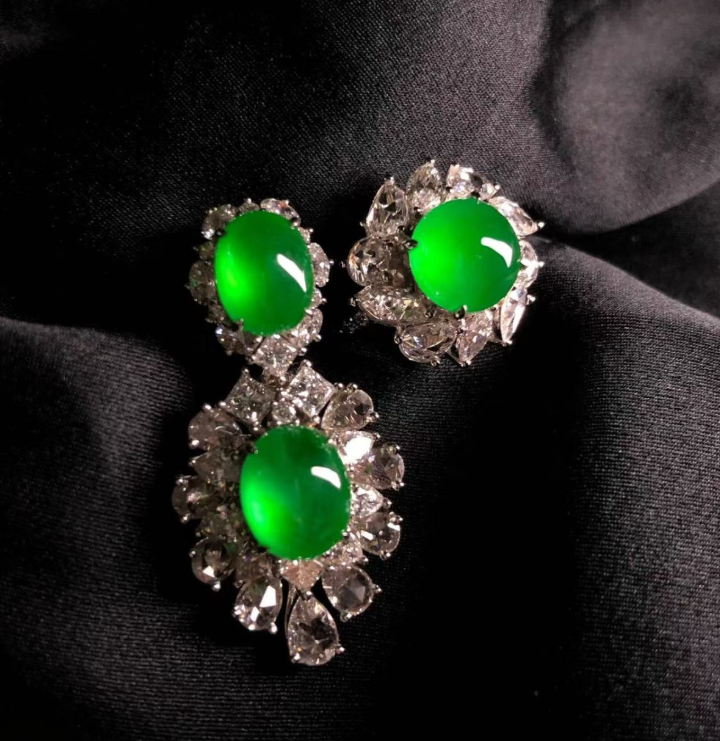
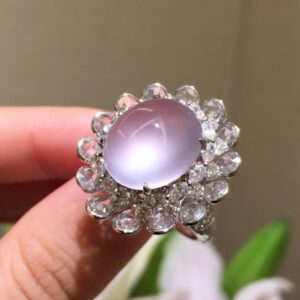
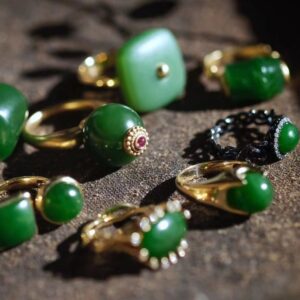
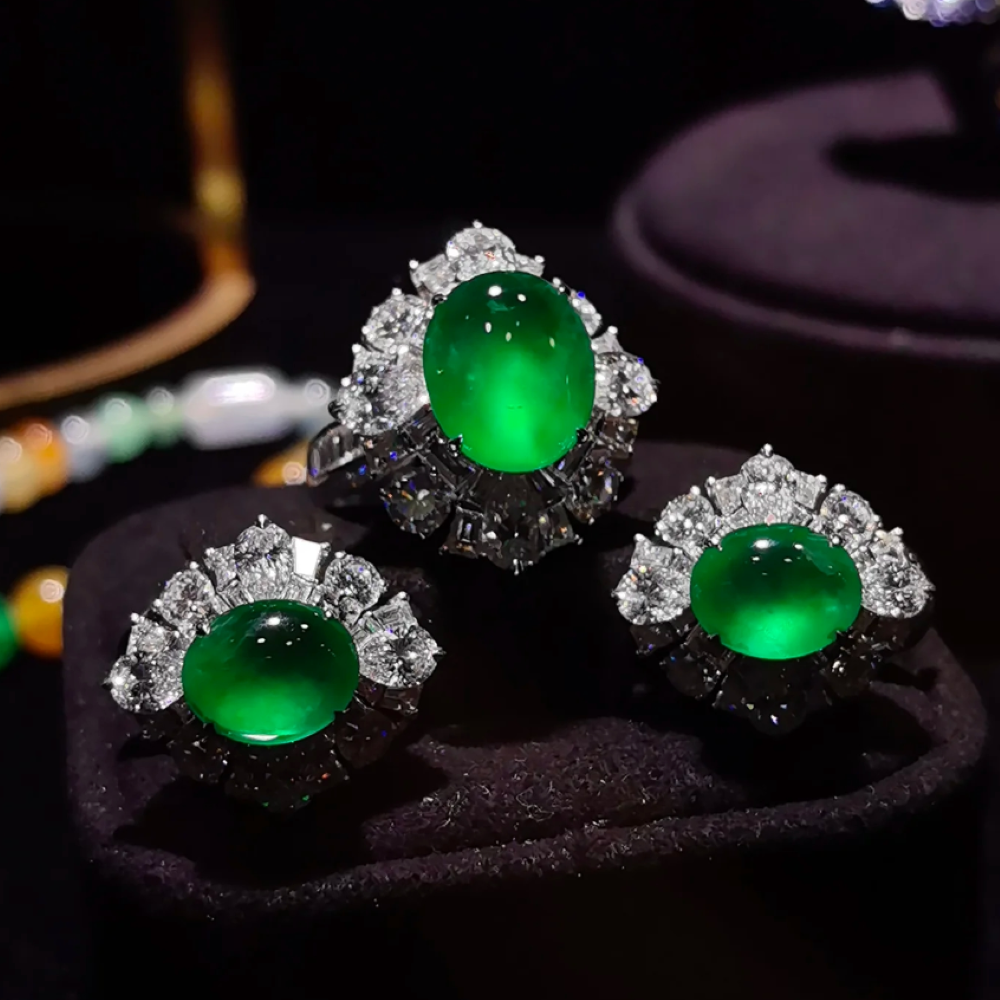
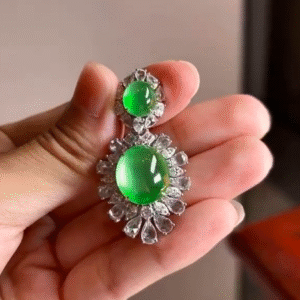
After having your first jadeite bangle, the journey usually deepens into a set of jadeite jade rings and earrings – made from jadeite cabochons.
The jade bangle is intimate and spiritual which connects your soul to natural jadeite, and it stays quietly with you every day. While the jadeite cabochon is something shining. From there, jadeite jade steps fully into the realm of high jewelry. This is where collectors begin to compare, refine, and elevate their tastes and standards.
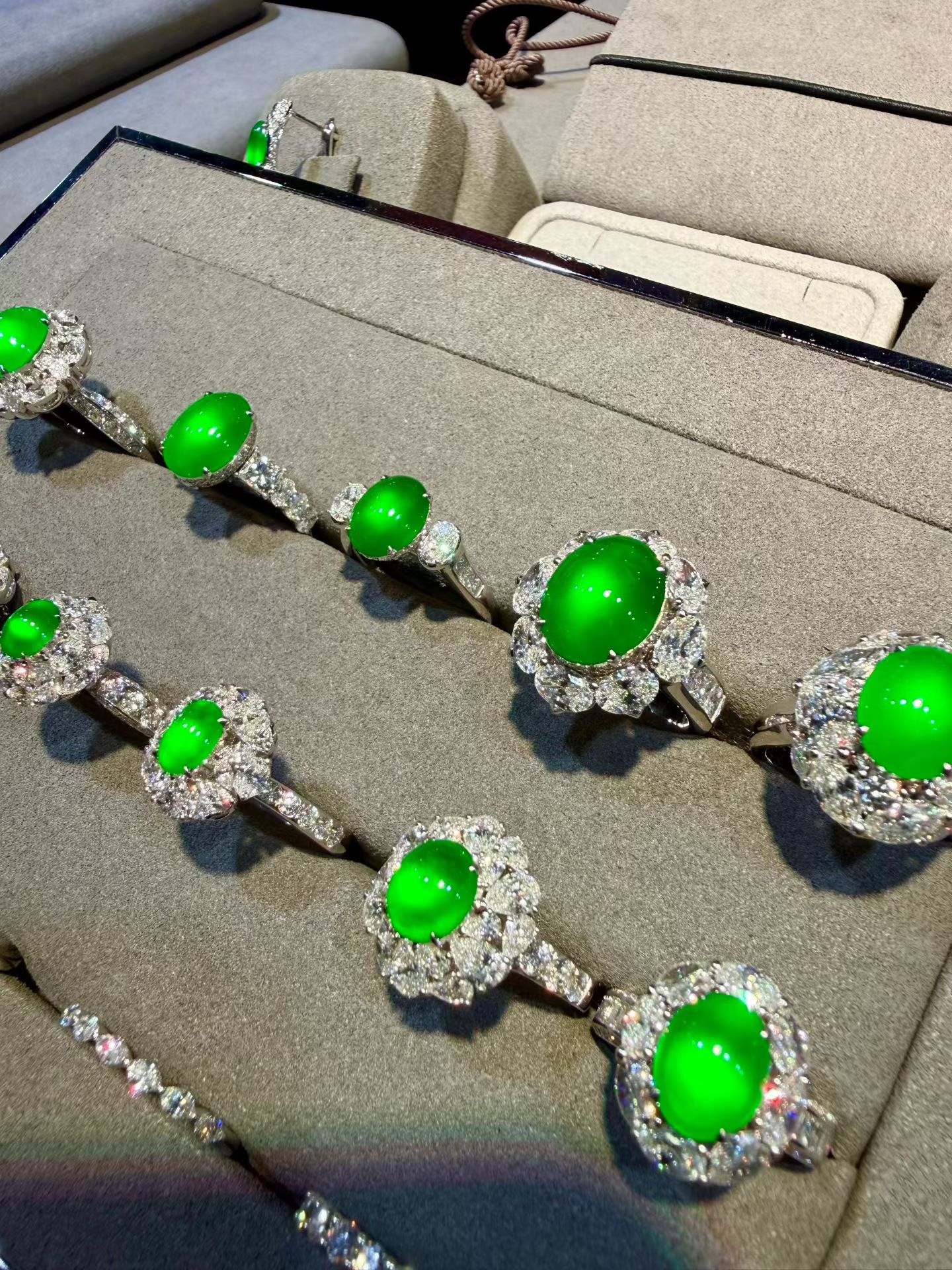
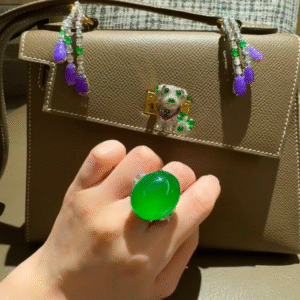
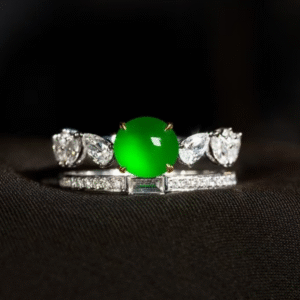
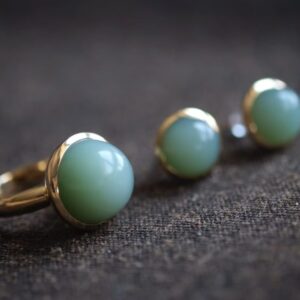
For serious jadeite collectors who has high budget, a few sets of premium quality jadeite cabochon ring and matching earrings of different colors and styles are a must-have. They represent concentration of color, of structure, of grain and glow, of light, of purity, of rarity, and of value.

Simple in Shape, Extreme in Requirement
A jadeite cabochon looks minimal. A smooth dome. Clean polish. No carving. But this shape is actually one of the most demanding cuts in the jadeite jade world.
A cabochon exposes everything. There is no design to hide uneven color. No carving to distract from flaws. The curved surface magnifies internal texture. Even slight cotton-like structure, faint lines, or uneven grain become visible once polished.
To create a high-quality jadeite cabochon, the rough must contain a concentrated, clean, structurally fine section. Most natural jadeite rough cannot provide this. Large portions are cut away and discarded in order to isolate a suitable area. It must be eye-catching. The yield is extremely low.
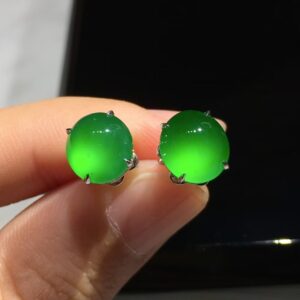
For earrings, the difficulty doubles. Two stones must match in tone, saturation, translucency, size, and dome proportion. Finding one beautiful jadeite cabochon is rare. Finding a truly harmonious pair is significantly rarer. This is why fine jadeite cabochon earrings sit firmly within the top tier of jadeite jewelry collection.
What Makes a Fine Jadeite Cabochon?
In the jadeite jade world, collectors focus on four key aspects to evaluate quality and value of a jadeite cabochon. They are color, grain and glow, clarity and cracks, shape and size.
Jadeite’s Color
Color is the most immediately perceived attribute of jadeite jade. In evaluating a cabochon, collectors apply the classic standard of "intense, bright, pure, and even" — known in Chinese as "浓、阳、正、匀".
Intense refers to what collectors call "thickness"—the color feels dense and rich, not thin or washed out. But here is the tricky part: if the color is too deep, it can start to look dark and lose its life. The sweet spot is color that is intense yet still bright.
Bright is that lively energy — what connoisseurs describe as "阳" — that makes the stone come alive under light.
Pure means the hue is free from muddy or grayish tints. The famous "imperial green" gets its rich emerald color from chromium—the same element that colors emeralds. Research shows that high-quality jadeite green actually has a slight yellow undertone.
Even means the color is uniformly distributed across the smooth, curved surface of the cabochon. Any color zoning or blotchiness is easily visible and affects the overall quality.
When collectors assess a jadeite cabochon’s color, they look at how well it performs on these four dimensions — whether it is a deep imperial green or a delicate lavender.

Jadeite’s Grain and Glow
In Chinese evaluation for jadeite jade, grain and glow which is called "种水" (zhongshui) in Chinese, is the foundation of jadeite’s beauty. A cabochon with beautiful color but poor grain and glow will look lifeless; a cabochon with excellent grain and glow can shine even with minimal color.
Grain refers to the texture of the jadeite—specifically, how fine or coarse its internal crystal structure is. When collectors say a piece has "old grain" (老种), they mean the crystals are so tightly packed and fine that they are almost invisible to the naked eye. When they say "new grain" (新种), the structure is looser, coarser, and often feels less solid.
Glow is what happens when the grain is fine enough. Light enters the jade, travels through its tightly packed structure, and emerges with a special energy. There are two types of glow that collectors prize:
- "起莹" (qi ying)— often translated as "fluorescence" or "glowing effect." This is a soft, floating light that seems to emanate from within the stone, usually appearing as a gentle, watery sheen along the curved surface. It is not the same as the glitter of a diamond; it is softer, more internal, almost mysterious.
- "起胶" (qi jiao)— often called "greasy" or "jelly-like" quality. The jade takes on the appearance of a drop of thick oil or melted jelly—smooth, translucent, with a sense of viscosity. When you move the stone, the light seems to flow and shift like a slow-moving liquid.
When grain and glow reach their ultimate level, they create what collectors call "light performance"—a phenomenon that top-tier players in the Chinese market now pursue the most. This is the realm of Longshi (Dragon Stone variety), the highest expression of grain and glow. Longshi is so rare that it is said to be as difficult to find as a mythical dragon. What sets it apart is its unique glow: a cold/chilling, sharp/insense, laser-like radiance that feels almost glassy cat’s eyes. In today's high-end Chinese collector market, a cabochon of imperial green Longshi, when its size is big enough for a significant ring or pendant—its value can easily reach one million US dollars.

Clarity and Cracks in a Jadeite Cabochon
When evaluating a jadeite cabochon, clarity refers to what you can see inside the stone. Natural jadeite often contains soft white inclusions sometimes described as “cotton” by collectors. These appear like faint floating fibers within the jade. Light and subtle inclusions are normal and they reflect the stone’s natural formation. However, heavy white patches can dramatically reduce the value of a cabochon. Dark mineral spots are also normal and common. A tiny speck near the edge of a cabochon may be acceptable, but bigger dark spots in the center of the dome can reduce both beauty and value.
Cracks are a more serious problem. Jadeite can contain internal lines formed long ago during its geological history. Some are healed and stable, but others may weaken the stone. Because a cabochon has a smooth curved surface, cracks are difficult to hide. A obvious crack line across the dome can lower the stone’s value a lot.
It is important to remember that natural jadeite is never perfectly flawless. Unlike glass or synthetic materials, genuine jadeite will always show some internal structure if examined closely. A small amount of natural texture or inclusion is normal and even helps confirm that the jade is real and untreated.
For collectors seeking a high-quality jadeite cabochon, the goal is not absolute perfection. Instead, the best stones are those where any natural structure remains subtle and does not distract from the two qualities collectors prize most: color and grain & glow. When viewed at a normal distance, the cabochon should appear clean, luminous, and free of obvious spots or cracks.
Shape and Size of a Jadeite Cabochon
When evaluating a jadeite cabochon, shape and size is another key influence on both its beauty and its value, but it is a simple to judge for everybody.
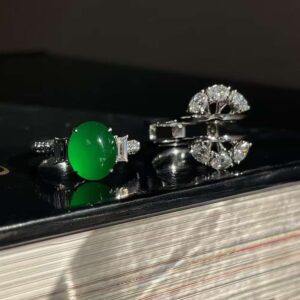
The most classic shape is the oval, which follows the natural structure of the jadeite and sits elegantly in jewelry settings. While round, pear, and other shapes exist, oval cabochons remain the most valuable and sought after by collectors.
In jadeite, the most desirable cabochons have a full, well-domed profile. Instead of appearing flat, the stone should rise smoothly from the base to a rounded peak. This height is important because the dome allows light to move through the jadeite and return to the eye, enhancing the stone’s color and glow.
Proportion also matters. For an oval jadeite cabochon, collectors often look for a balanced relationship between length and thickness. A commonly perfect proportion is close to 2:1. For example, a cabochon that measures around 10 mm in length may ideally have a thickness of about 4.5mm–5 mm. Achieving this kind of fullness is extremely difficult, especially in high-quality jadeite. Because good jadeite rough is limited, cutters are often forced to make stones thinner to avoid cracks or inclusions. As a result, thick, richly domed cabochons are so rare.
Size also plays an important role in cabochon’s value as well. Larger cabochons require larger pieces of high-quality rough, which are extremely rare. A fine cabochon measuring 15 mm can be many times more valuable than a smaller stone if it also maintains strong color, grain and glow, clarity, and a full dome.

Finding Your Right Jadeite Cabochon
Choosing a jadeite cabochon ultimately comes down to understanding the balance between the four core pillars: color, grain and glow, clarity and cracks, shape and size. In reality, no single cabochon can possess absolute perfection in every aspect. For jade collectors, it is key to know what matters most to you. Some prioritize rich green color and accept minor internal cotton. Others prefer exceptional translucency
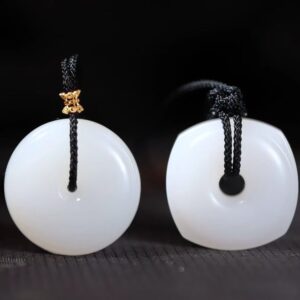
and fine grain and they accept lighter or darker color or very small size. A beautiful cabochon is one that fits both your aesthetic preference and your budget.
Cabochons are also among the most difficult jadeite pieces to judge from photographs or videos. Lighting, angles, and editing can dramatically change how a stone appears. This is why experienced collectors prefer to compare stones side by side under different lighting conditions whenever possible.
For collectors in the Middle East, Hermit Jade will soon open a store and welcome jade lovers to come, compare, and learn. We are committed to help global collectors develop a deeper understanding of jadeite quality.
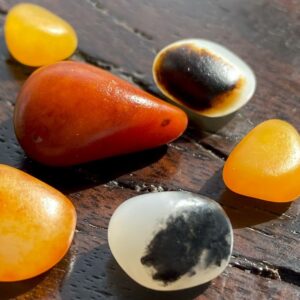
For serious collectors seeking exceptional stones, our VIP sourcing service helps clients acquire top-tier jadeite cabochons. Many collectors around the world trust our expert eyes to locate rare stones that may never appear on the open market. We also welcome jade lovers to visit China for a jade discovery journey, we guide our clients through the jade markets and help them find the cabochon that truly speaks to them.
Jadeite collecting is a lifelong pursuit. With the right knowledge—and the right guide—the search for the perfect cabochon becomes part of the beauty of the journey.